SEO for financial services that compliance can approve
For advisors, wealth managers, fintech, banks, credit unions and insurers. We build the authority Google expects on money topics, inside your compliance review process, and report the result in consultations, sign ups and revenue.

























Indexed vs. advisor website platforms vs. a generalist SEO agency
| Indexed | Advisor website platforms | Generalist SEO agency | |
|---|---|---|---|
| Compliance workflow | Built into the content calendar | Prewritten content with approvals handled | Usually an afterthought |
| Original content | Written from your advisors' expertise | Shared library used on many sites | Generic copy from non specialists |
| E-E-A-T and technical SEO | Audited and fixed | Limited by the template | Technical yes, YMYL signals rarely |
| AI answers (ChatGPT, AI Overviews) | Included, with dated screenshots | Not covered | Sometimes covered |
Why financial firms struggle to grow in search
Clients check you out on Google before they call, and Google holds money topics to a higher standard than almost anything else.
Drafts written without the rules in mind come back covered in edits, so publishing stalls for weeks and the content calendar quietly dies.
Comparison sites and personal finance publishers with large editorial teams take the head terms, while your firm has no plan for the specific searches it could win.
No named authors, thin bios and regulatory details hidden in the footer. Prospects and Google both look for the people behind the advice and can't find them.
SEO for financial services: what it takes to rank
Every step runs through the Full-Stack Search Method™: technical SEO, content, links, local search and AI visibility as one program, led by senior strategists.
Why Google treats financial sites differently (YMYL and E-E-A-T)
Google's Search Quality Rater Guidelines (September 2025 edition) define Your Money or Your Life topics as those that could significantly impact people's health, financial stability or safety, with "how to invest money" among the examples and a dedicated category for YMYL Financial Security. The same guidelines call trust the most important part of E-E-A-T, and say any site involving financial transactions should make clear who is responsible for it. Google's guide to creating helpful, reliable, people-first content also strongly encourages accurate bylines.
In practice, every advice page needs a named author with real credentials (CFP, CFA, CPA or equivalent) and a bio page, a visible review date and citations to primary sources. Your About, team and contact pages should state who owns the firm and how it is regulated.
What the SEC marketing rule means for your pages
We are not lawyers, and your compliance team keeps final sign-off. For US investment advisers, Rule 206(4)-1 covers communications that offer advisory services. The SEC's small business compliance guide lists seven general prohibitions, including material statements you cannot substantiate and benefits discussed without fair and balanced treatment of risks. Testimonials and endorsements must clearly and prominently disclose whether the person is a client and whether they were compensated, and gross performance cannot be shown without net performance. The SEC staff's marketing compliance FAQ adds detail on performance periods and third-party ratings. For SEO, that shapes how you feature reviews, ratings and results: even reviews shown on your website can count as testimonials, so agree the approach with compliance first.
FINRA Rule 2210 and FCA financial promotions
US broker-dealers. FINRA Rule 2210 splits communications into correspondence (25 or fewer retail investors in 30 days), retail communications and institutional communications. A registered principal must approve each retail communication before use, and content must be fair and balanced, with no false, exaggerated, promissory or misleading claims. A public web page usually reaches far more than 25 retail investors, so expect it to need approval before it goes live.
UK firms. The FCA's financial promotions rules require every promotion to be clear, fair and not misleading, whatever the medium, across loans, investments, savings, insurance, pensions, mortgages and payment services. Its FG24/1 guidance applies the same standard to social media and influencers.
What to target in each financial services segment
Advisors and wealth managers. The highest-intent searches combine a service with a place or a client type: "financial advisor in [city]", "fee-only financial planner", "retirement planning for business owners". Build one page per service, office and niche. The 2024 Kitces Report found niche-focused firms were more likely to use SEO (39% vs 24%).
Fintech and payments. Searches are product-led: features, "best [category] software", comparisons and free tools. Treat it like SaaS SEO with a compliance layer.
Banks, credit unions and insurers. Demand is branch, product and situation led ("life insurance with diabetes"). Branch pages and product pages that answer rate and eligibility questions do most of the work, within your regulator's promotion rules. Tax advisors, see SEO for accountants.
Local SEO for financial advisors
For most advisory firms, the map pack is where new clients start. Google's guidelines for representing your business name financial planners as individual practitioners, so a public-facing advisor who can be reached at a verified office during posted hours can have their own Business Profile. In a practice with several advisors, the firm holds a profile for the location and each advisor's profile uses only their name. A solo advisor working under a brand shares one profile named in the "[brand]: [practitioner name]" format. Virtual offices are not allowed unless staffed. Each office also needs a page with consistent name, address and phone details and the advisors based there. Our guide to optimizing a Google Business Profile covers the setup, and our local SEO service handles it end to end.
Technical SEO for financial websites
Financial sites have a few technical problems that most sites don't:
- Calculators and rate tables. Tools built entirely in JavaScript often show Google an empty page. Render the explanation and key figures in HTML.
- Client portals. Keep logins and account areas out of the index without blocking the CSS and scripts your public pages need.
- Disclosures. Put risk warnings in HTML, not images, and keep them in shared templates so a compliance change is one edit, not hundreds.
- Structured data. Mark up your firm, offices and authors with Schema.org's FinancialService type and its subtypes.
- Scale without bloat. An investor discovery platform we worked with reached 20k+ indexed pages after its architecture was rebuilt around country, city and industry templates.
Our technical SEO service covers audits and fixes.
Get named when prospects ask AI about money
Prospects now ask assistants where to find a fee-only planner nearby, which tools handle a specific payment problem, or where to search a database of investors. Google says its AI features use the same foundation as search: indexed pages that are eligible to show as snippets, with no special markup required. ChatGPT search relies on OpenAI's OAI-SearchBot being able to reach your site, so check it isn't blocked in your robots.txt or firewall rules. The credentialed, compliant content above is what those answers draw on, and we check it against a fixed set of prompts for your market. See our SEO audit and strategy service for where to start.
Why financial services firms choose Indexed
Financial firms usually get one of two kinds of help: a website platform with a shared content library, or a generalist agency that has never sat through a compliance review. We sit between the two. Senior strategists write with your advisors or product team, with their credentials on the page, and agree a claims and disclosures library with compliance before the first draft.
Drafts arrive close to approvable, so review takes days, not weeks.
Prospects and Google can see who is behind your advice and why they're qualified to give it.
You show for searches that signal someone is ready to engage, from retirement planning for business owners to product comparisons.
Consultation requests, sign ups and revenue from search each month, so SEO can be judged like any other channel.
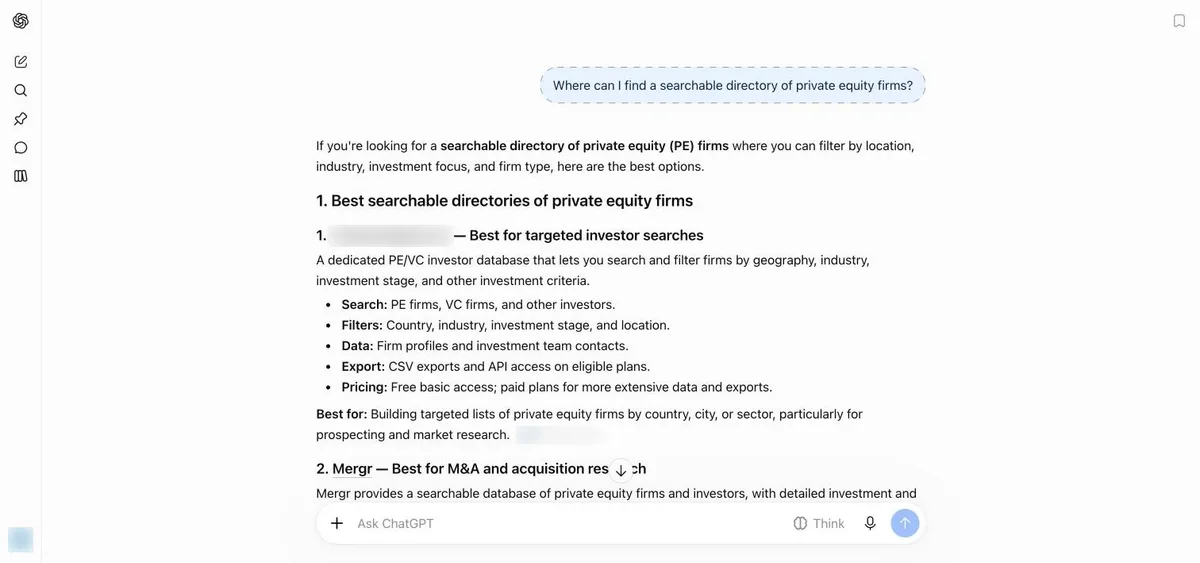
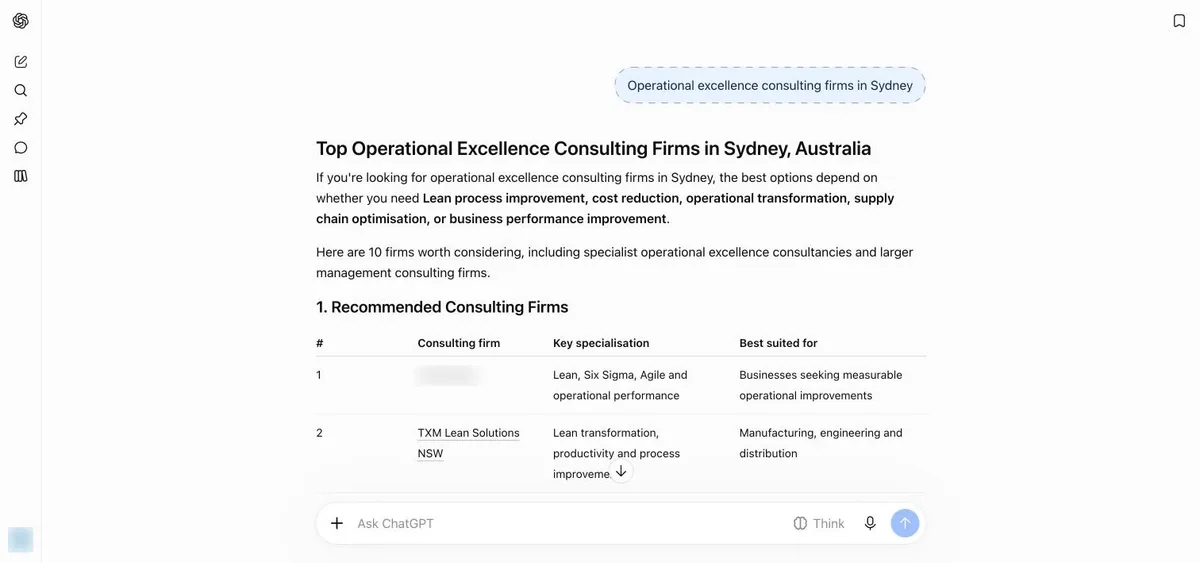
Recommended by ChatGPT, not just ranked on Google.
We asked ChatGPT and Perplexity the questions our clients' buyers ask. In 7 of the 10 answers we checked, our client comes first. The prompts are exactly as typed; client names are blurred because our case studies are anonymous.

What a few more clients a month are worth
Move the sliders to your own numbers. It shows what extra clients from search would add up to over a year.
An illustration using your numbers, not a forecast or a promise. Results depend on your market, starting point and how well enquiries convert.
Get a free estimate for my marketAnswered.
How much does SEO cost for a financial services firm?
At Indexed, the full-stack managed service starts from $2,500 per month, scoped to your segment, number of offices or products and your compliance workflow. You can start with a free video review of your site or a one-time $2,000, 30-day AEO Sprint. Prices are in USD.
How do you handle compliance for financial services SEO content?
Your compliance team keeps final sign-off. We agree a claims and disclosures library with them up front, build their review into the content calendar, write educational content that doesn't need a hard sell, and keep a dated record of what went live. We don't give legal advice, but we know where the SEC marketing rule, FINRA Rule 2210 and the FCA's financial promotion rules usually affect SEO work.
Does E-E-A-T really affect rankings for financial sites?
Google says E-E-A-T itself isn't a specific ranking factor, but its systems give even more weight to content with strong E-E-A-T on topics that could significantly affect people's financial stability. Named authors with real credentials, primary-source citations and clear information about who runs the firm are how a financial site shows it.
What does a financial advisor SEO audit cover?
Technical health (crawling, indexation, speed, and whether calculators and disclosures are readable by Google), E-E-A-T signals (author bios, credentials, About and contact pages, regulatory details), local presence (the Google Business Profile setup for the firm and each advisor) and content gaps against the searches your ideal clients make. You get a prioritized list with compliance-sensitive items flagged.
What ROI can a financial services firm expect from SEO, and how do you measure it?
We track consultation requests, qualified leads and revenue, not just traffic. Results depend on your market and starting point, so we won't promise a multiple. For reference, an investor discovery platform we worked with returned 2x its $48k SEO investment over 24 months.
For a fintech company, how does SEO compare to Google Ads?
Paid search buys visibility right away and stops the day you stop paying. SEO takes months to build but keeps bringing in sign ups from pages you own, which is why many fintech teams run both and shift budget as organic grows. Comparison, alternative and free tool pages usually pay back first.
Can you get our firm recommended by ChatGPT?
We can't guarantee it. We make sure OpenAI's search crawler isn't blocked, build the credentialed, compliant pages those answers draw on, and track a fixed set of prompts monthly with dated screenshots.
Start free. Scale when it pays.
Every engagement starts with a free video review of your site. From there, run a 30-day project or hand the whole program to our team.
Personalized video review
A senior strategist records a video of your site covering Google rankings and AI visibility.
- Who buyers find instead of you, and why
- The fixes worth the most, in order
- In your inbox within days, yours to keep
The AEO Sprint
A senior specialist embedded with your team for 30 days. You end the month with work live, not a report.
- Week 1: we find the opportunities
- Week 2: we build the plan with your team
- Weeks 3 and 4: we ship the quick wins
Full-stack SEO, AEO and GEO
Our full team: strategy, technical SEO, content, links, local, AI visibility, web and analytics.
- Reported against enquiries, pipeline and revenue
- Senior strategists on every account
- Scoped to your goals, packages customized
Prices in USD. The Sprint is $2,000 once; managed packages start at $2,500 a month and are customized to your requirements.
Free video review
A senior strategist records a video of your site: where you rank, who buyers find instead of you and what to fix first.
Foundation
Technical fixes, call and form tracking, and your core pages and profiles brought up to standard so new work can rank.
Build
New and rewritten pages for the searches that lead to revenue, reviews and links under way, and a baseline of AI answers recorded.
Compound and report
Monthly reporting on enquiries, pipeline and revenue with dated AI answer screenshots, and more effort on whatever is working.
See where your firm stands in search and AI
Send us your website. A senior strategist will record a video showing where you rank in Google, Google Maps and ChatGPT for the searches your best clients make, with any compliance-sensitive issues flagged.
Get my free video review