
Key findings
- 1.Of 2,318 AI answers that recommended at least one business, 79% named only competitors and never the business whose customers were asking.
- 2.55% of the 284 small businesses we studied were never named by ChatGPT, Perplexity, Gemini or Google’s AI Overviews across 12 answers each.
- 3.Perplexity and Google’s AI Overviews still named only 44% of the businesses they had recommended about 6.5 months earlier (91 of 206 recommendations). Gemini’s recommendations barely changed.
- 4.In the US and UK, about two in three of the businesses AI recommended instead of the business being asked about were local independents. Outside the US and UK, chains and national brands took most of those spots.
- 5.In the US and UK, businesses with 10 to 99 monthly Google visits won the AI recommendation 36% of the time, against 19% for businesses with no Google traffic.
- 6.When AI recommended a business, it cited that business’s own website in 60% to 86% of cases, depending on the engine.
The same customer questions, asked months apart
Between April and November 2026, 284 small businesses ran our free AI Visibility Checker. For each one, the checker wrote three questions a real customer would ask, based on the business’s own website, and stored what the AI engines answered. On November 16 we asked all 852 questions again on ChatGPT, Perplexity, Gemini and Google’s AI Overviews, twice, and compared who got recommended. The method and limits are at the end of this page.
- “My furnace isn’t working, who repairs heating in [town]?”
- “Best inground pool builders in [city] with reliable crews?”
- “Are there any hair loss treatments with a money back guarantee?”
- “Online conveyancing price comparison for selling my house”
- Home services and trades65
- Professional, B2B and tech60
- Health, wellness and beauty35
- Retail, creative and makers34
- Food, travel and events29
- Other or unclear61
New to some of these terms? Plain-English definitions
- Recommendation:
- A business named in an AI answer as one to use or contact.
- Perplexity and Gemini:
- Two AI assistants people use like ChatGPT: Perplexity is an AI search engine, and Gemini is Google’s assistant.
- Google AI Overviews:
- The AI-written summary that appears above the regular results on some Google searches.
- Organic Google traffic:
- Visits from Google’s regular (unpaid) results, estimated by Ahrefs.
- Domain Rating:
- Ahrefs’ 0 to 100 score for how strong a website’s backlinks are.
- AEO and GEO:
- Answer engine and generative engine optimization: work aimed at getting a business named in AI answers.
- Closest fit: local and home-service businesses in the US and UK. Home services and trades were the largest group in the study (65 businesses).
- Outside the US and UK: the picture is harsher. Three in four businesses were never named, and chains took most of the spots.
- Professional, B2B and tech firms: bigger brands took most of the spots, so the “local rival” finding doesn’t hold for you.
- Already getting steady Google traffic? Most businesses here got little or none. The Google finding levels off past the first few dozen visits a month, but the turnover and who-replaces-you findings still apply.
Most small businesses never make the shortlist
Across 12 answers each (three questions on four engines), 55% of businesses were never named at all. When an answer did recommend someone, 79% of the time it named only competitors. The typical business was named in none of its 12 answers, while 7 of them recommended only its competitors.
It varied by industry. Home services and trades did best, along with health and beauty: 43% were never named. Professional, B2B and tech firms (58%) and retail and makers (62%) did worst.
Are you in the 55%?Run the same check on your business. It takes about 2 minutes.Check now →In the US and UK, the seat usually goes to the business down the road
When AI left a US or UK business out, about two in three of the businesses it recommended instead were local independents, and about one in four were chains or national brands. Outside the US and UK it flipped: chains and national brands took most of the seats.
We also followed businesses that AI had named about six months earlier and then dropped (more on that in Finding 5). Across every country in the study, the answer that replaced them named a local competitor 60% of the time. One answer can name several kinds of business, so these add up to more than 100%.
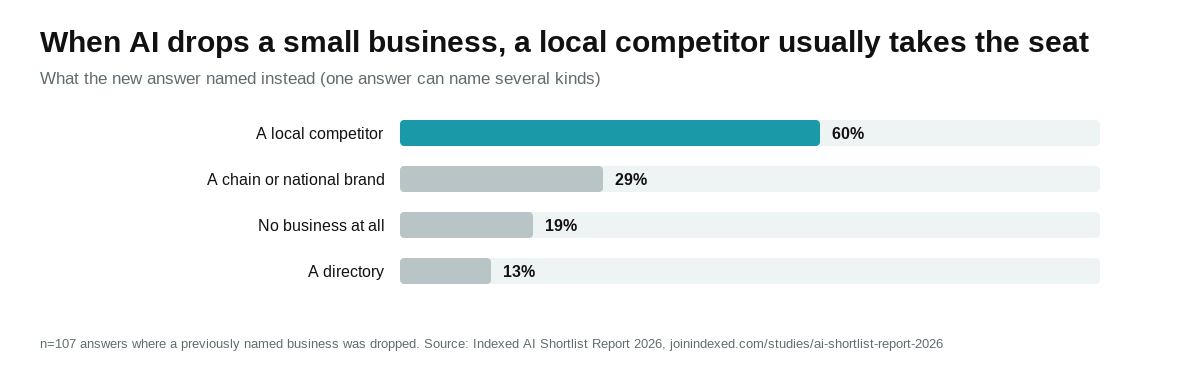
The exception was professional, B2B and tech firms, where bigger brands took most of the seats.
You don’t need to be big on Google. You need to be on Google.
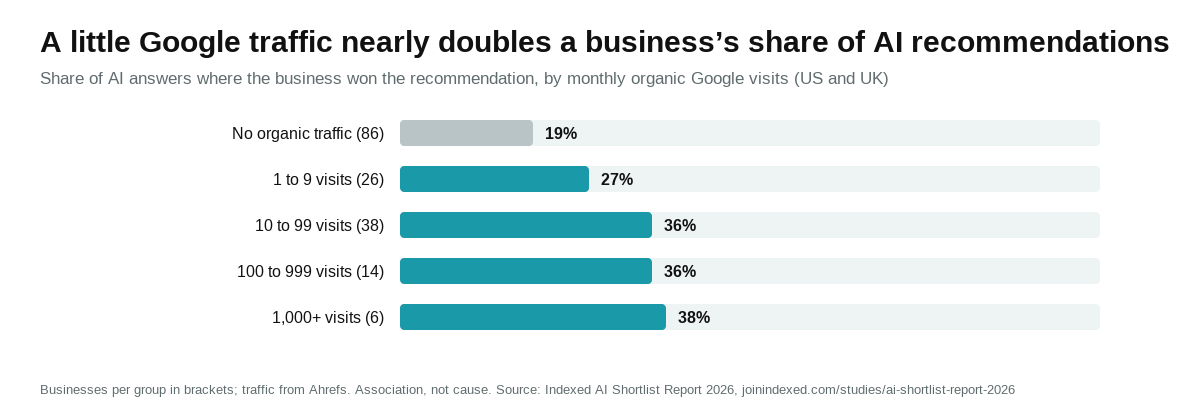
In the US and UK, businesses with no organic Google traffic won the AI recommendation in 19% of answers. With 10 to 99 visits a month, that rose to 36%, and then it leveled off. The step that mattered was from none to some.
AI reads your website before it recommends you
When AI recommended a business, the business’s own website was usually among the sources it cited. One caution: our questions were written from each business’s own site, which may make its site an easier match than it would be for a general question. Even so, a business can’t count on other sites alone to speak for it.
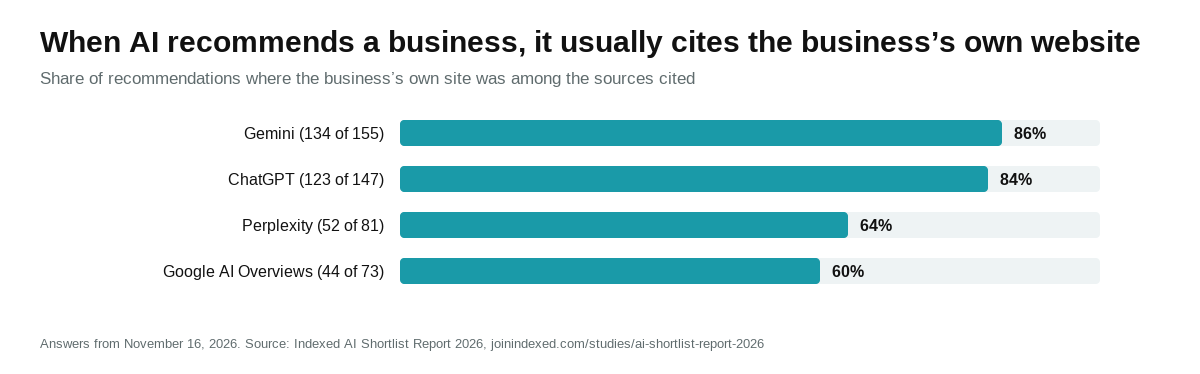
Google’s AI Overviews also leaned on Google itself: Google’s own listings of businesses, places and products were among the sources in 42% of its answers, ahead of YouTube (26%), Facebook (25%) and Reddit (17%).
Being recommended once doesn’t mean staying recommended
We followed 206 recommendations that Perplexity and Google’s AI Overviews had made in the original check. About 6.5 months later, 91 were still there. 115 were gone, and 114 recommendations went to businesses that had not been named before. The number of seats barely changed. Who sat in them did.
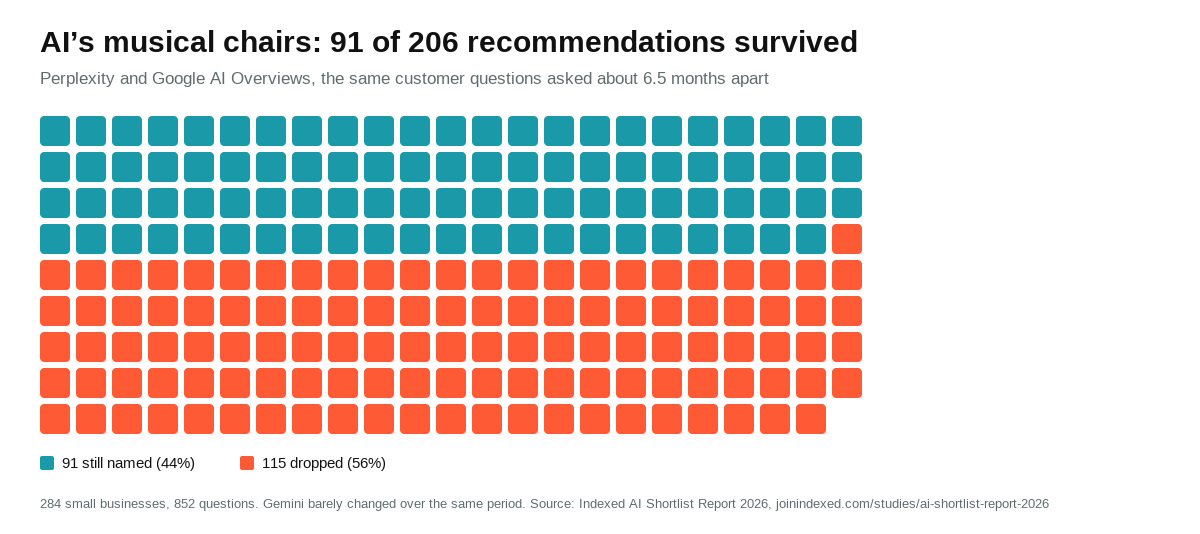
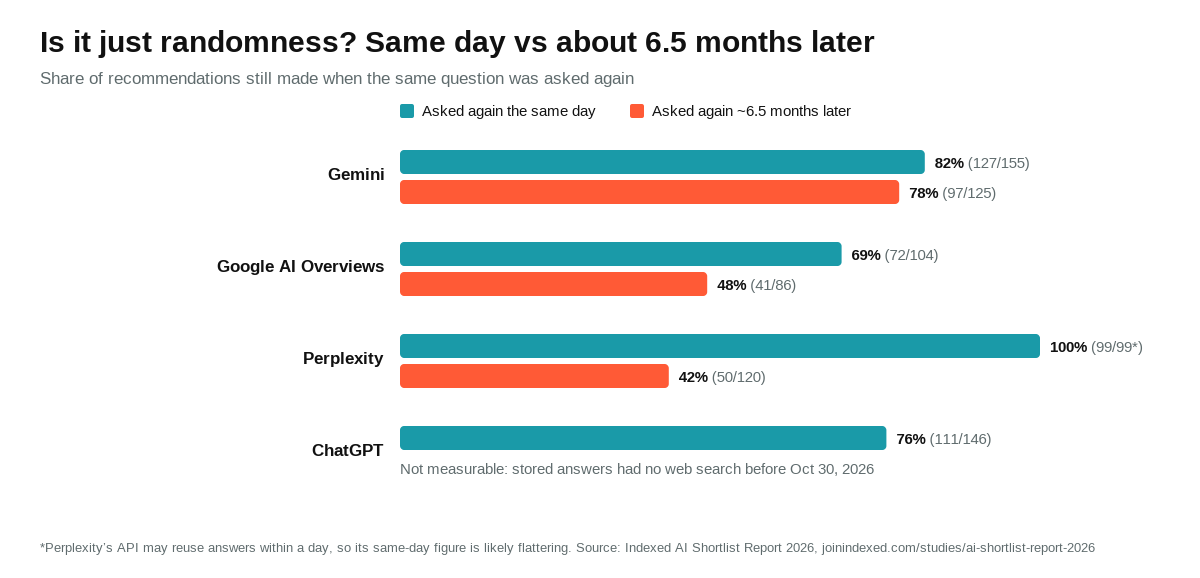
Is that just AI being random? We checked by asking every question twice on the same day. On Google’s AI Overviews, 69% of recommendations held up the same day, against 48% after about six months, so part of the change is more than chance. Perplexity looked even steadier day to day, but its API may reuse an answer within a day, so we can’t prove its six-month change the same way. Gemini was stable both ways, and ChatGPT’s older answers can’t be compared, so the headline holds for two engines, not all four.
One real question, six months apart
- Heating company A
- Heating company B
- Heating company C
- Heating company D
- Heating company E
- Heating company F
- The business that ran our check
- Heating company E
- Heating company G
- Heating company C
- Heating company H
- Heating company I
Four things that mattered less than we expected
- Domain Rating helps a little, but not as much as you’d think. Among US and UK businesses, 41% under DR 10 were never named, against 34% at DR 10 to 29 and 36% at DR 30 or more (only 11 businesses). Businesses at DR 20 or more also kept their AI spot more often (56% against 40%), but most of that gap came from Google traffic: among businesses that all had some, it shrank to 50% against 47%. Google traffic explained most of the gap.
- Every engine reshuffling. Gemini kept 78% of its picks over six months, about the same as when we asked it twice on the same day. The turnover is a Perplexity and AI Overviews pattern.
- How long ago the first check was. We saw no clear pattern between businesses checked in April and those checked later, though the groups are small.
- How the question was phrased. Urgent, “near me”, price and “best” questions all landed within a few points of each other.
We report these because a study that only finds what its authors sell isn’t worth much.
Three things the data says to do
This is the order we work in with clients: SEO as the foundation, with AEO and GEO on top. See how we work.
No time or team to do this yourself?We do this for clients, in the order above. Start with a free video review: a personal walkthrough of where competitors beat you on Google and in AI answers, why AI names them and not you, and a 90-day action list. No call needed.Get my free video reviewSee who AI recommends instead of you, and what to fix first
The 20-page report breaks the results down by industry and country, shows what the businesses AI kept naming had in common, and ends with a 10-step checklist and a printable tracker you can fill in tonight.
Free. We email you the PDF, once.
Frequently asked questions
Do AI recommendations change over time?
On some engines, yes. In our study, Perplexity and Google’s AI Overviews still named only 44% of the businesses they had recommended about 6.5 months earlier. Gemini’s recommendations barely changed. Asking the same question twice on the same day gave far more stable answers, so the change over months was more than day-to-day randomness.
How often does AI recommend small businesses?
Not often. 55% of the 284 small businesses we studied were never named across 12 answers each, and 79% of the answers that recommended anyone named only competitors.
Do AI engines prefer big brands over small businesses?
In the US and UK, mostly not. When AI left a US or UK business out, about two in three of the businesses it recommended instead were local independents. Outside the US and UK it flipped, and chains and national brands took most of the seats. Professional, B2B and tech firms were also an exception: bigger brands took most of their seats.
How do I get my business recommended by AI?
Our data points to the foundations. Businesses with even modest Google traffic won the AI recommendation about twice as often as businesses with none, and AI cited the recommended business’s own website in 60% to 86% of cases. Because recommendations change, it also pays to check where you stand regularly.
Which AI engine is most likely to recommend a small business?
In our study, Gemini and ChatGPT with web search named the business most often (18% and 17% of questions), against 12% for Perplexity and Google’s AI Overviews. The engines rarely agreed: when one named a business, all four did only 12% of the time, so check all of them, not just one.
Can I use these findings and charts?
Yes. Quote the findings with credit to Indexed and a link to this page. Every chart has an embed code that includes the credit.
Methodology and limits
Sample. 284 businesses that ran the Indexed AI Visibility Checker between April and November 2026, after removing tests, duplicates and marketplace-hosted shops: 73 in the US, 97 in the UK, 87 elsewhere and 27 unknown. They chose to use a free tool, so they are not a random sample of all businesses.
Questions and answers. Three buyer questions per business, written from its own website. Engines were reached through their APIs; Google AI Overviews were collected from a US location. A business counts as named when its name or domain appears in the answer or its site is cited.
Engines and runs. ChatGPT (gpt-5.4 with web search), Perplexity (Sonar), Gemini 2.5 Flash with Google Search grounding, and Google AI Overviews. On November 16, 2026 we asked all 852 questions on all four engines, then asked a second time the same day: 433 questions on ChatGPT, Perplexity and AI Overviews (every question where any engine had named the business, plus a random 150) and all 852 on Gemini. The original answers had been stored when each business ran the checker, a median of 196 days earlier. The businesses each answer recommended were extracted with an AI model, and traffic and Domain Rating come from Ahrefs. The engines were called through the same code that runs our free AI Visibility Checker and Indexed Signal, our in-house tracker.
Comparisons over time. The months-apart comparison uses Perplexity and Google AI Overviews. ChatGPT is excluded because its stored answers had no web search before October 30, 2026. Engines and the web both changed over the period, so the study shows what changed, not why.
Limits. Group sizes in the breakdowns are small, so they show direction rather than precise effects. Labels for local and chain businesses were assigned with AI help and spot-checked. Every link between factors here is an association, not proof of cause. No business is named anywhere in this study.
Who we are. Indexed is an agency that sells SEO, AEO and GEO services, so we have an interest in these results. To keep that from shaping them, we report the findings that don’t favor us and state the limits above.
How to cite this
Using a figure from this page? Please credit it like this:
Source: Indexed, "Who AI Sends Your Customers To: The AI Shortlist Report 2026", November 2026, joinindexed.com/studies/ai-shortlist-report-2026