Key Takeaways
- SEO takes 4 to 12 months for most sites, and ranking has gotten slower: only 1.74% of new pages reached the top 10 within a year in Ahrefs' latest study, down from 5.7% in 2017.
- Three shortcuts get sold as fast SEO: bought spam links, mass AI pages and easy ranking guarantees. Google ran four spam updates in 2026 to catch them.
- A healthy first year has three stages: foundation (months 1 to 3), traction (months 4 to 6) and growth (months 7 to 12).
- It works when the foundation is right: one trade business went from 19 to 32 clicks a day by month five, about 70% more.
- Ask any agency four questions before you hire them. If they guarantee rankings, walk away.
Most sites need 4 to 12 months to see real results from SEO. For years, Google gave the same range in its own guide to hiring an SEO, and anyone promising page one in 30 days is usually selling a shortcut that will cost you more later.
Not sure whether your SEO is building something that lasts? Get a free video review of your site from the Indexed team.
Every year, business owners come to us after being burned by that promise. They paid an agency or freelancer for fast rankings, didn't get them, lost faith in SEO and moved the budget to paid ads. This guide explains why SEO takes time, and how to spot the agencies that won't waste yours.
Watch: why quick SEO growth is an expensive mistake
Jump to a chapter:
- 0:00 Intro
- 0:55 The “page one in 30 days” promise
- 1:19 How long SEO takes, according to Google
- 2:02 Why ranking takes longer than it used to
- 2:41 Three shortcuts sold as SEO
- 5:08 Why shortcuts cost more now
- 5:43 If an SEO guarantees first place, find someone else
- 6:02 The first year, done properly
- 8:56 Proof: a trade business in Australia
- 10:23 Four questions for any agency
- 12:25 Where to start: the 30-day sprint
Why does SEO take 4 to 12 months?
SEO takes 4 to 12 months because Google has to crawl, understand and trust your site before it ranks it for competitive searches. For years, Google's guide to hiring an SEO said it typically takes four months to a year from the time you begin making changes until you start to see the benefits. The current version of that guide drops the number and tells you to ask any SEO what results to expect, and in what timeframe. In our experience, the range still holds.
Where you land in that range depends on three things:
- Your website: its authority (how long DR takes to build), technical health and history
- Your keywords: how commercial and how contested they are
- Your competition: who already holds page one, and how strong they are
Ranking is slower than it used to be
Ahrefs tracked 1 million random URLs its crawler first saw in September 2023, and published the results in May 2025:
- 1.74% of new pages reached Google's top 10 within a year
- 5.7% was the same measure in 2017
- 5 years is the average age of a page ranking #1, up from 2 years in 2017
The helpful content update, AI Overviews and AI Mode have all raised the bar. You can still win some low-competition keywords quickly, and they may bring a few leads. The commercial searches that drive revenue take longer.
The 3 shortcuts sold as “fast SEO”
When clients tell us how a previous agency or freelancer got them quick results, the tactics nearly always fall into three buckets.
- Bought links. Not every paid link is a problem. A link from a relevant site in your niche, bought through a trusted vendor, can be fine, and the best links are earned, for example when other sites cite original research you've published. Buying spam links in bulk from the wrong vendors will tank your rankings. Our guide to link building strategies that work covers the earned side.
- Mass AI pages. Hundreds or thousands of pages generated with AI, with no keyword research, no personalization and no understanding of what your buyer wants. Google's spam policies name this scaled content abuse: many pages made mainly to manipulate rankings rather than help users, however they're produced. We've written about when programmatic SEO backfires for the same reason.
- Easy guarantees. “We'll get you to page one.” And they do, for keywords nobody searches when looking for your product or service. The promise is technically kept, but you get no leads, no customers and no revenue.
Why shortcuts cost more in 2026
Google has run four spam updates in 2026: March, June, August and September. The September update finished on October 8. And since May 15, Google's spam policies also apply to its generative AI answers in Search, which means attempts to manipulate AI Overviews and AI Mode count too.
Get caught and you damage your site's reputation and your brand's. Google may stop surfacing you for the commercial keywords you care about, and its AI may never mention you.
Google's hiring guide is blunt about guarantees: “No one can guarantee a #1 ranking on Google.” If an SEO guarantees you first place, it says, find someone else.
What does a healthy first year of SEO look like?
A healthy first year moves through three stages: fix the foundation, build traction, then compound. Here's how we run a 12-month engagement at Indexed.
- Months 1 to 3: Foundation. We learn your niche, competitors, site history, target audience and what your sales team already knows. We run a full technical audit, then re-optimize what you have: high-priority technical fixes and site architecture changes where needed. Everything later compounds on this, so it has to be right.
- Months 4 to 6: Traction. With the foundation fixed, we double down on content: landing pages, blog posts and newsletters if you want them, aimed at the right keywords and the right audience. This is usually when you start to see movement.
- Months 7 to 12: Growth. Relevant, trusted sites link to you, people trust your brand, and Google starts to as well. Now we go after the high-value commercial keywords that can put you in the top three to five, bringing in leads, discovery calls and form fills.
That's close to impossible in month one. It's very possible in 6 to 12 months, depending on where your site starts.
Proof: about 70% more clicks by month five
A trade business in Australia started with us in May. For the first two months, clicks stayed flat. That was expected, because we were fixing the technical foundation. Then they climbed, steadily.
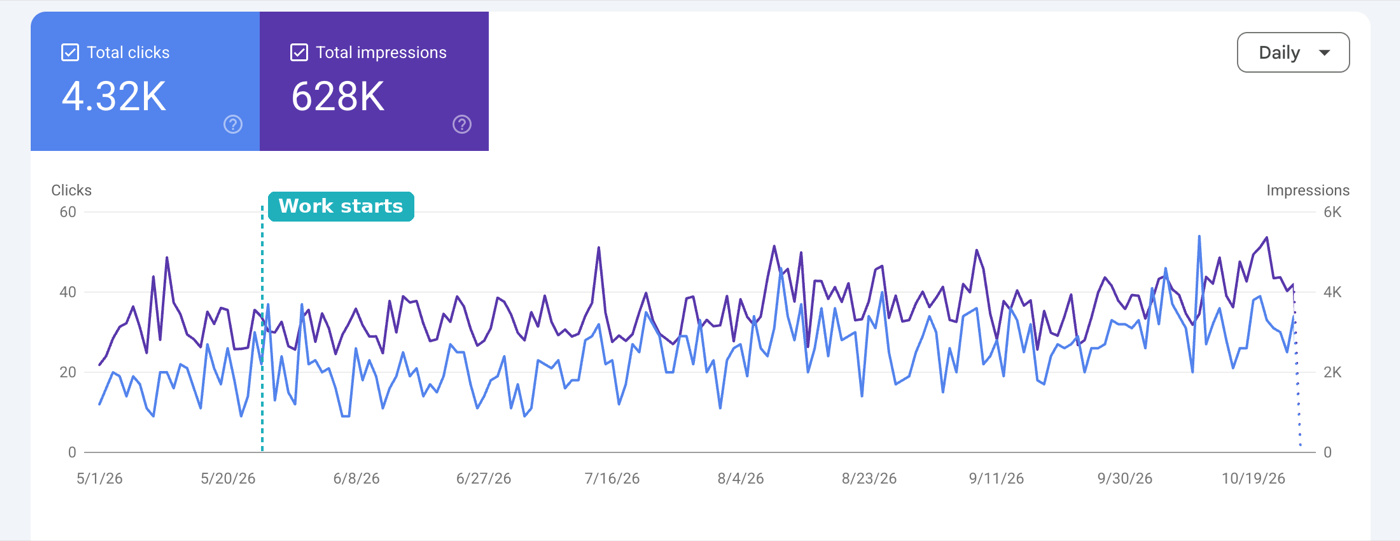
| Metric | June | October (so far) | Change |
|---|---|---|---|
| Clicks per day | 19 | 32 | +68% |
Impressions rose about 30% over the same period (daily averages, Google Search Console). No tricks, no spikes: just a foundation starting to pay off.
4 questions to ask an SEO agency before you hire
Ask these four questions of any agency or freelancer. Their answers tell you whether they're building something that lasts. For more on vetting, see how to hire an SEO expert without getting burned.
- What exactly will you do in the first three months? A good answer covers learning your niche, competitors, audience and site, then fixing and re-optimizing so the base is right.
- How will you get links? Earned links come first. Any paid links should come through trusted vendors, from sites relevant to your niche. If the answer is vague, like “we've got a guy”, that's your answer.
- What will you report on? Traffic and clicks are fine, but they should also report leads: organic leads, discovery calls and marketing-qualified leads from tools like HubSpot or CallRail, plus revenue if they can see it. Our SEO reporting guide lists the metrics worth asking for.
- Do you guarantee rankings? It's a trick question. If they say yes, walk away. At Indexed, we tell clients straight: we're confident we can earn good rankings for the keywords that matter, and it will take time.
FAQ
How long does SEO take to work?
Most sites need 4 to 12 months to see real results, the same range Google's guide to hiring an SEO gave for years. Where you land depends on your site's authority, your keywords and your competition.
Can an SEO agency guarantee page one rankings?
No. Google says no one can guarantee a #1 ranking, and if an SEO guarantees first place you should find someone else. Guarantees usually mean ranking for keywords nobody searches.
Why is my SEO not showing results after 2 months?
The first three months usually go into the foundation: technical fixes, audits and re-optimizing existing pages. Clicks often stay flat until months four to six, when that groundwork starts paying off.
Are paid backlinks bad for SEO?
Bulk spam links from the wrong vendors can tank your rankings. Links from relevant sites in your niche, bought through trusted vendors, are lower risk, and earned links are always best.
Where to start
Not sure whether your current SEO is building a foundation or chasing shortcuts? Get a free video review from the Indexed team. We'll look at your site and tell you what we'd fix first.
Ready to go further? Our 30-day sprint gives you a full performance audit, the high-priority fixes, a few pieces of content and a roadmap you can run yourself. It doesn't promise rankings in 30 days. It makes sure everything after it is built on something solid. After the month, turn it into a retainer or take the roadmap and go.
Related reading

Written by
AnirbanHead of Content, Indexed
Anirban is Head of Content at Indexed. He runs the search side of client work end to end, from the audit to the roadmap to what ships, and makes videos about what healthy SEO looks like.
What to read next
One email a week
How to turn search into revenue.
One idea a week from live client work: what we changed, what it was worth, and what you can take from it.
One email a week. Unsubscribe in one click.